Unit 17
Be observant for signs or complaints of pain, and report this to the nurse.
Be very aware of noise in the hall, talking to other caregivers, laundry, and maintenance carts, and waking them for v/s can make a huge barrier to adequate sleep. Organize v/s with toileting and checking times. If a resident wakes naturally through the night, try to encompass all care giving while in the resident's room.
Avoid turning on the overhead light when entering a residents room to check on them or to reposition, rather use a lamp or a small flashlight. A bright over head light is more than needed and can result in the resident fully awakening and prevent them from falling back to sleep.
Be aware of the person’s normal times for going to bed and getting up in the morning, and try to maintain this routine as much as possible.
Help the person follow familiar and comforting bedtime routines, such as reading.
Make sure that the person has the opportunity to empty their bladder and bowels before bed.
Promote physical activity during the day. Exercise helps to promote better sleep.
Many elderly people do require a nap during the day to meet their sleep requirements (because older people tend to sleep more lightly and awaken more frequently throughout the night compared with younger people). However, taking too many naps or napping for too long
can affect the person’s ability to sleep at night. Disease process can cause a resident to require more rest periods.
CNA responsibilities:
Create a restful environment. Ensure that the person’s linens are clean and wrinkle-free and that the person is not too warm or too cold. Minimize noise as much as possible, and close the curtains or blinds. If it is necessary to give care during the night, turn on only as much light as you need to safely complete the task and try to provide necessary care when the resident wakes naturally rather than waking them again.
Pain and Rest
How does pain affect your sleep?
People with chronic pain often experience less deep sleep. They also wake up more often during the night and hence experience less efficient sleep. It is found that people who experience pain are eighteen times more likely to experience clinically diagnosed insomnia. Pain affects sleep quality as well as quantity.
What the C.N.A can do to help.
*Nonmedication pain relief such as hot and cold therapy
*Light touch backrubs
*Take a little time to position for comfort using several pillows.
*Follow bedtime rituals, brush teeth, wash face, PJs, read a book, watch TV, pray, use the restroom.
Monitor for pain
*Ask your resident if they are in pain, use a scale of 0-10 with 10 being the most horrible pain possible.
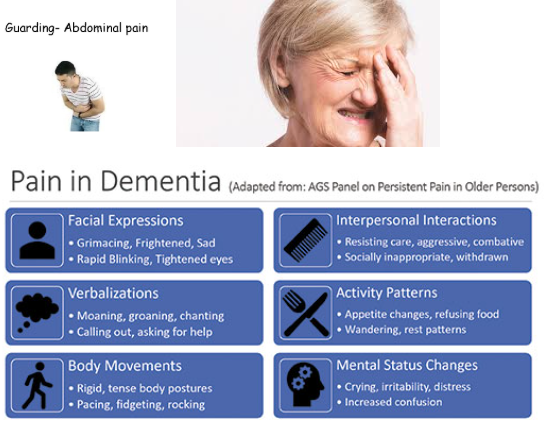
*Look at your resident for signs of pain that they may not be telling you. Some cultures believe it is a sign of weakness to complain about pain. Some people have dealt with it so long they feel there is nothing that can be done, others do not have the ability either physically or mentally to speak or express their pain and they need you to watch for signs of pain and to do what you can and then to report it to the nurse.
Signs of Pain
* Guarding a place on their body
* Facial grimace
* Grinding teeth or clenching their jaw.