
Unit 12
Be sure to watch all videos on this page
How to Record Blood Pressures
Tools needed to take Blood Pressure
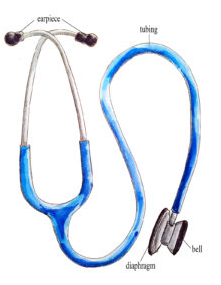
Stethoscope is a medical instrument used in listening to sounds produced within the body.
A sphygmomanometer (also know as a blood pressure cuff) has three parts:
a cuff that can be inflated with air,
a pressure meter (manometer) for measuring air pressure in the cuff, and
a stethoscope for listening to the sound the blood makes as it flows through the brachial artery (the major artery found in your upper arm).
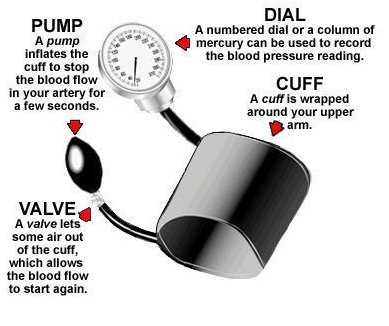
The smaller lines on a gauge are in increments of 2, so all blood pressure results should all end in an even number when taken manually.
Examples: 116 over 76 or 122 over 84
Measuring And Recording Blood Pressure
Before you begin, ensure your equipment is clean and serviceable. Wash your hands thoroughly. Greet your patient, and tell them that you are going to take their blood pressure. Then, follow these steps to get an accurate result:
1. Verify the identity of your resident. Wrap the blood pressure cuff around the resident’s arm, just above the elbow. Ensure you can comfortably reach the bulb of the cuff.
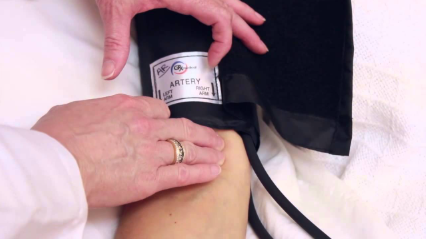
2. Place the bell of the stethoscope over the brachial artery, located in the bend of the elbow. Don't not use your thumb to hold the bell in place. Your thumb has a heartbeat and can affect what you are hearing.
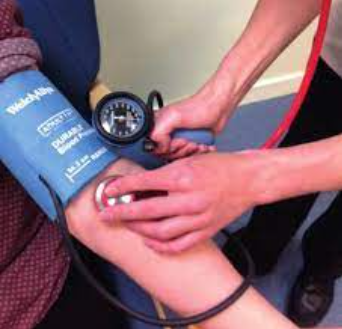
3.Make sure the valve is twisted all the in. Begin pumping the bulb of the blood pressure cuff. Watch the dial on the cuff, and continue squeezing the cuff until the needle reaches between 150 and 180 mmHg.
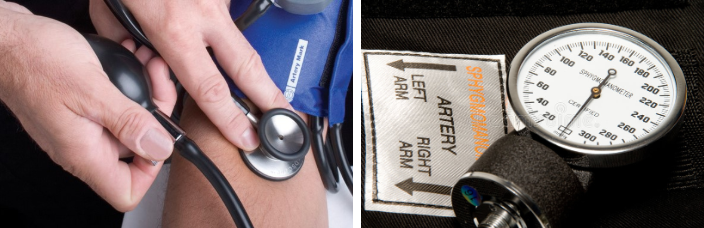
4. Slowly release the pressure by lightly loosening the valve on the blood pressure cuff while listening through the stethoscope.
5. When you first hear a pulse (also known as the Korotkoff sounds), note the number on the meter. This is the upper number, called the systolic pressure. This is the pressure exerted on the arterial walls when the heart beats.
6. Continue listening to the pulse, and wait until you hear the pulse fade away. Again, note the number on the meter. Wherever the needle is when you hear the last number is the lower number, and is called the diastolic pressure. This is the pressure on the arterial walls when the heart is at rest.
7. Record the results. The number is usually recorded as systolic over diastolic, for example, 120 over 80. 120/80
8. Wash your hands, and wipe down equipment with anti-bacterial wipes.
The blood pressure measurement is one of the most used diagnostic tools in medical offices. By carefully measuring and recording this information, you are creating an important record that will be used by the physician to determine what, if any, treatment a patient may need. It is important to note that some residents have cardiac conditions that need frequent monitoring and can vary greatly.
A normal systolic blood pressure should be between 100-140. Report anything less than 100 or over 190. A normal diastolic pressure should be between 60-90. Report anything less than 60 or more than 100.
NOTE: High blood pressure is called Hypertension abbreviated as HTN and the medical term for low blood pressure is Hypotension.