
Unit 12
Oxygen saturation is an important vital sign as it shows us how well someone is moving oxygen through their body. Oxygen saturation offers an objective look at whether the organs and brain are getting sufficient oxygen, despite how the resident may feel they are breathing. For example, someone having a panic attack may feel like they can’t breathe and may appear to be in great distress, but their oxygen saturation could be sitting at 100%, and truthfully, if they continue to gasp for air they are much more likely to hyperventilate.
Pulse Ox Machine
We use a device called a pulse ox machine to determine someone’s oxygen saturation. This device can be placed on the toe, earlobe, or even nose, but is more commonly placed on the finger. It sends out a red beam of light through the nailbed that determines what percentage of blood cells are carrying oxygen. A normal, healthy individual should have an oxygen saturation of 95-100%.
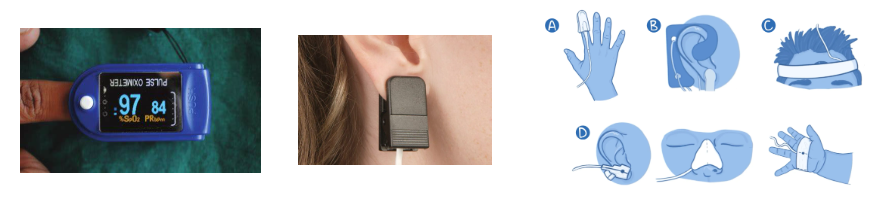
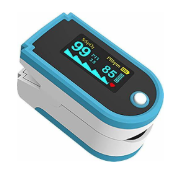
The pulse ox machine, often referred to as a POX machine, offers two numbers- the oxygen saturation which is usually depicted as “SPO2%” on the machine, and the pulse rate usually depicted as “PR”. The pulse is there not just to aid you in getting your vital signs, but also to verify the accuracy of the oxygen saturation reading. For example, if the machine is giving a reading that doesn’t appear to match how the resident looks or how they are behaving, you can doublecheck the pulse on the machine to a manual pulse taken radially to determine if it is accurate. If the pulse on the machine does not match the radial pulse than the oxygen saturation is also inaccurate.
The pulse ox machine may also offer a visual pulse shown as rising and falling bars or as a waveform. When placing the device on a resident, you should wait until the waveform appears uniform without breaks. It will take a second or two to get an accurate reading.
Things that may interfere with a good reading:
Movement can disrupt the reading. Have the resident hold still. If they have an involuntary tremor, such as with Parkinson’s, you may lay their hand flat on their leg or on a table and gently hold your hand over theirs to keep the hand still.
Poor circulation and cold hands. Massage the arm from just below the elbow all the way to the tip of the finger, moving blood that direction. Applying a hot pack or warm blanket to the hand can also increase circulation. Or simply hold the finger in your hand to warm it up. If you can’t get a reading it may be necessary to try a different route.
Nail polish. Sometimes nail polish- particularly the older acrylics or very dark colors can block the red sensor. It may be necessary to remove the nail polish or try a different route.
Documenting an Oxygen Saturation
When documenting an oxygen saturation your reading should always be followed by a “%” sign. This also distinguishes it from a pulse rate. In addition, it should also indicate any supplemental oxygen used. For example, if a resident is on 2 liters (L) of oxygen through a nasal cannula (NC) when you took the reading it should be documented as “95% 2L nc”. If the resident is on 6 liters of oxygen via mask it should state, “95% 6L mask”. If the resident was not on any oxygen when the reading was taken it should be documented as room air (RA)- “95% RA”.